Why should retailers and boutiques take a physical inventory? It’s easy to feel like you’ve got a great system, you know your numbers, or feel like it’s a lot of work you don’t have time for.
But knowing actuals in your inventory really matters.
If you have been in retail for any length of time you have most likely heard horror stories of store owners complaining about the dreaded “inventory” days. Often, taking a physical inventory meant days of counting, tally marks, and missed sales. Those days are behind us with improvements in technology, scanners, SKU’s, and barcodes!
As painful as this process might have been,it is non-negotiable and considered a mandatory business practice for any retailer.
Comparing what you have on paper or in your Point of Sale System to what you actually have on hand will identify errors among technology or personnel, inconsistencies, and causes of shrinkage.
You can’t sell what you don’t have!
If your data isn’t accurate you might miss out on sales when you realize the inventory you thought you had on hand actually doesn’t exist. You need to submit inventory counts to your accountants for tax purposes, and your insurance agent for all insurance coverage so it is important and responsible to have accurate numbers.
And you might also identify shrinkage or theft in your business.
Why Is Taking Physical Inventory Important?
- Run full Inventory counts at least once per year or run cycle counts once per month. (Cycle counts breaks your inventory down by inventory classifications, vendors, or specific sections of your store) Cycle counts allow the store owners to count smaller quantities at a time. Many retailers feel this is more manageable and puts them in a position to remain accurate throughout the year.
- When should retailers take a physical count? That totally depends on the retailer. Some stores prefer to do this right after the holiday, some prefer to take a physical count inventory in July. This completely depends on what makes the most sense for your business. Ideally, taking a count at the lowest level of inventory saves the counter time and we know time is money!
- Taking a full inventory count involves tallying up the number of each style number in your possession. To do this manually with a pen and paper is not nearly as accurate as using a barcode scanner and inventory management software. Most point of sale systems has built-in reporting features that make the task of taking a physical count inventory much simpler and more accurate.
If you choose to use inventory management software get to know the system to use it effectively for the counting purpose. Most systems use a scanner that syncs immediately to the Point of Sale system which reduces errors and redundancy.
Days before the BIG COUNT:
- Planning ahead and getting organized with personnel, supplies, and time is key to a successful count. Plan to take inventory on a certain day and make sure your staff is aware that daily activities will be disrupted during this time. Many businesses conduct their count after business hours to not disrupt business. If you do plan to take a count during normal business hours be prepared to communicate this with your customers and other staff members. Any inventory that is out on loan, approval, transfers or missing from your possession for some other reason needs to be counted as well. Take time before your count to gain possession of these items.
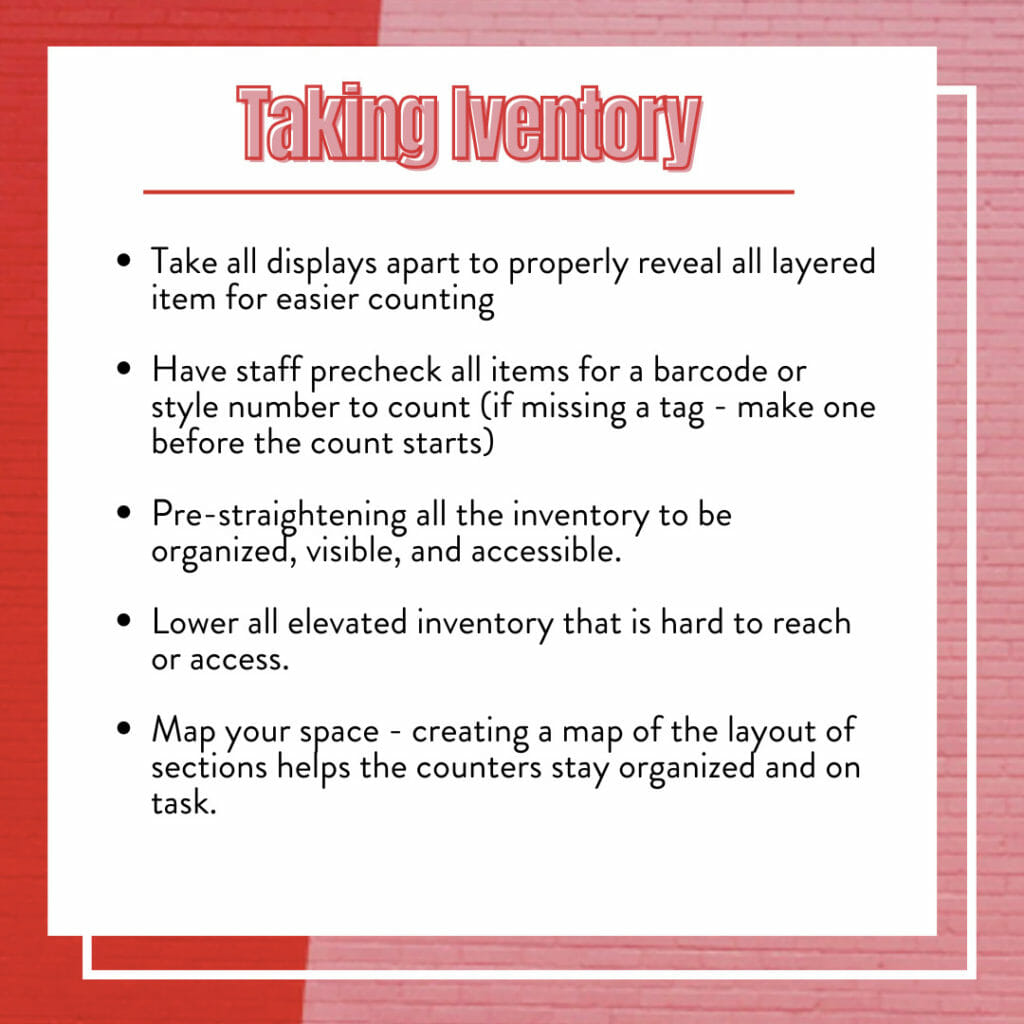
- Assign counting duties to qualified employees. If you are going to take time to actually count your inventory it should be done accurately. After all, the reason store owners do this is to find mistakes, not make them. Train, review, and train again! Accuracy is KEY!!! Some store owners hire this out, recruit outsiders as they fear their employees are too familiar with their inventory that they will forget or overlook items.
It’s COUNT time:
- Before you start your physical count it is important for you to run all your inventory reports before you get started so you can properly compare before and after! Again, check with the system you are using to make sure you are taking advantage of any built-in inventory management software abilities.
- Test your system for accuracy before you get too far into the process. Failing to test this only to find out there is an error in your process is a waste of time and money.
- Get Started – follow your plan – proceed until finished. Everything must be counted – scanned or physically tallied by price, sku or style number. Whatever your system is, keep it consistent. In the end – everything must be added up and entered into your system! (Point of sale system, Excel or CSV file or other inventory management software)

Reconcile – and Assess!
- Compare your results! It is important to address any discrepancies right away. All successful business owners ask WHY? Why is there a discrepancy? What caused it and how can we avoid it happening again? If you aren’t winning you are learning! Failing to learn from these discrepancies will ultimately lead to future mistakes!
- Adjust your numbers as needed in your bookkeeping system to match your Inventory Management system and inform your accountant. Inventory can’t just go missing or show up without an explanation! It is important that you properly document your audit.
Whether you are doing this with a pencil and paper or a bar code scanner and computer, the goal is to have accurate numbers at the end! Accurate inventory numbers mean less missed sales, motivated employees, and happier customers! You will be confident in your investments and able to make better decisions going forward.
Feeding or cutting inventory classifications is hard to do if you don’t have all the information. Taking the time to physically count your inventory at least once per year is a huge step in the right direction. After all, your inventory is your greatest asset, it should always be working for you rather than against you!
Let us know when you read this, shoot us a story over on the gram at @theboutiquehub or @ajalderson we’d love to hear what action you’re taking!
- The Boutique Hub at FLAIR Midwest Market
 Mode Market 2026 is raising the bar for dance retailers everywhere. In an exciting new partnership with The Boutique Hub, the February event will now open with a full day of business education designed to help retailers boost sales, sharpen strategy, and build stronger brands. Taking place Wednesday, February 4, 2026, at the Henry B. González Convention Center in San Antonio, this collaboration blends Mode Market’s industry expertise with The Boutique Hub’s proven track record of empowering independent retailers. From mastering email marketing to optimizing in-store merchandising and turning local wins into online growth, attendees will gain the tools and insights needed to thrive in today’s ever-evolving retail landscape.
 - #820: 13 Scariest Lessons I’ve Learned in Business | (Boutique Hub Turns 13!)
 What do 13 years of entrepreneurship really teach you? As The Boutique Hub celebrates its 13th anniversary, Ashley Alderson takes a step back to share the 13 biggest (and scary) lessons she’s learned from building a business through the highs, the lows, and everything in between. From imposter syndrome and burnout to leadership, hiring, personal… Read more: #820: 13 Scariest Lessons I’ve Learned in Business | (Boutique Hub Turns 13!)
 - Five Minute Friday: 3 Business Beliefs That Are Keeping You StuckWhat’s really keeping your business from growing? It probably isn’t your budget, your competition, or even your experience. It’s the beliefs you’ve accepted as truth. Samantha Conner shares three mindset shifts that separate business owners who stay stuck from those who continue to grow. Learn why waiting until you feel “ready” costs opportunities, how preparation… Read more: Five Minute Friday: 3 Business Beliefs That Are Keeping You Stuck
- #819: What 50+ Years in Boutique Retail Can Teach Today’s Store OwnersCan a boutique really survive for more than 50 years? Starting with just three pieces of jewelry in 1970, Linda Winter built Accessories With a Flair and Hair into a unique business that combines apparel, accessories, hair services, wigs, skincare, and personal styling. In this conversation, she shares the mindset that has helped her navigate… Read more: #819: What 50+ Years in Boutique Retail Can Teach Today’s Store Owners
- Five Minute Friday: The Psychology Behind Customer Loyalty and Higher SalesWant customers to buy more without feeling pushy? When people receive value first—whether it’s a small gift, helpful advice, premium content, or an unexpected surprise—they’re naturally more likely to trust your brand and return the favor. Samantha Conner shares practical ways retailers and wholesale brands can use reciprocity to build stronger customer relationships and increase… Read more: Five Minute Friday: The Psychology Behind Customer Loyalty and Higher Sales